
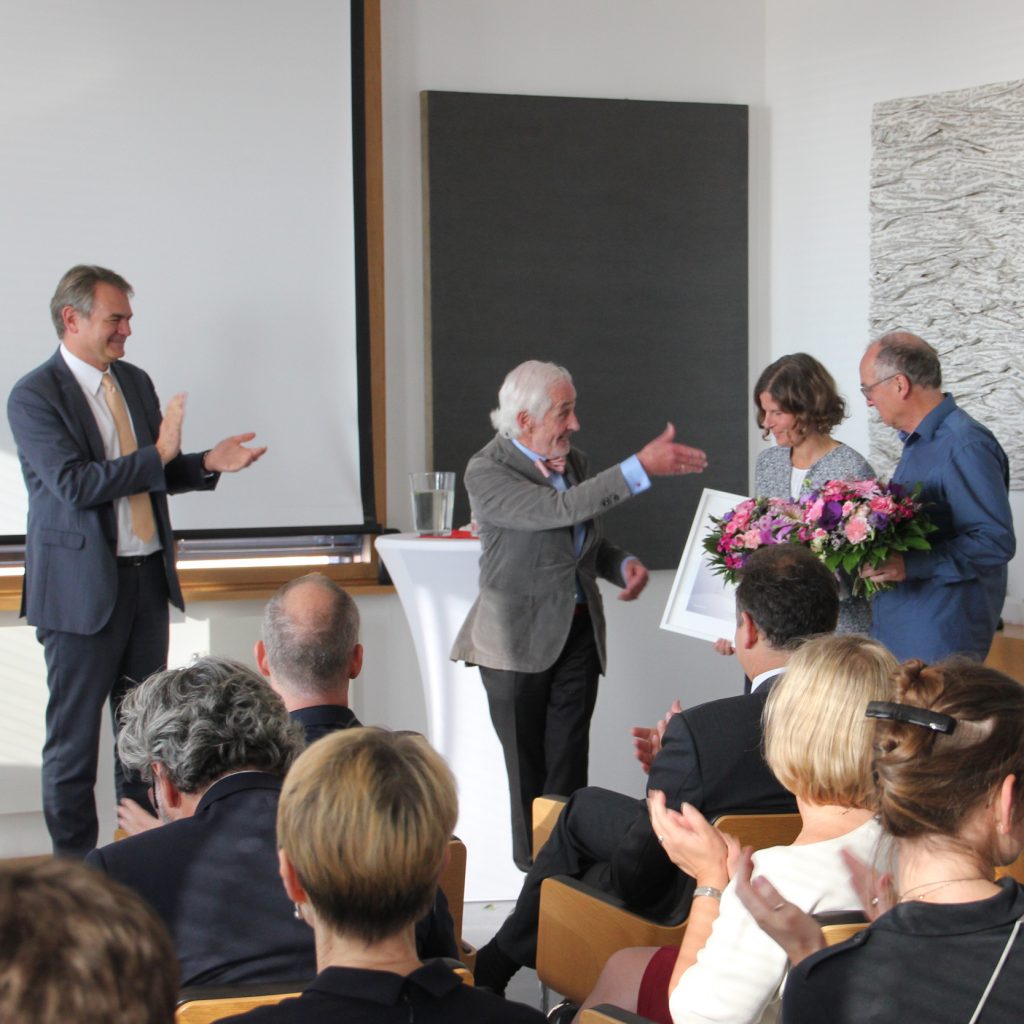
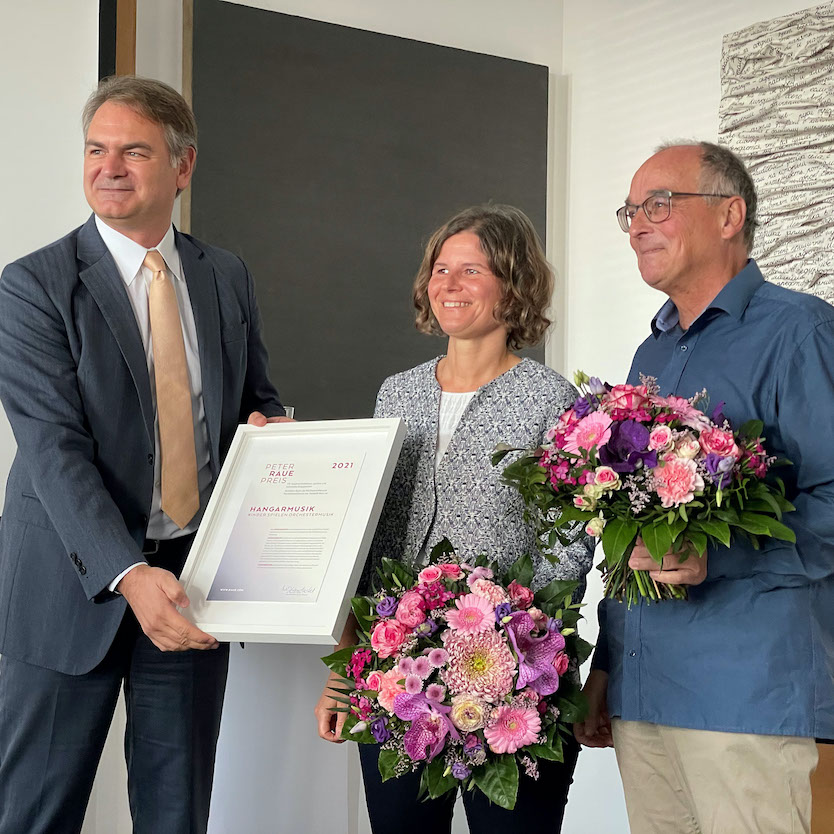
HANGARMUSIK was honoured with the first PETER RAUE PRIZE on 3 November 2021 at the premises of the RAUE Society in Berlin.
Commendatory speech by Dr Wolfram Hertel, Managing Partner of Societät RAUE
Dear Ms Weber, dear Mr Knapp, dear colleagues, dear journalists and guests and above all: dear Peter!
I would like to welcome you all to the inaugural presentation of the "Peter Raue Prize".
As the prize is "new", I would first like to say a few words to explain the award: The Society has established this prize in honor of your 80th birthday, dear Peter, and it will be awarded annually from now on. The prize money is 10,000 euros.
The Peter Raue Prize is designed to act as a "sponsorship prize". We do not want to honour celebrities with the prize, or institutions and initiatives that are already in the limelight and win prizes - Peter Raue is not a "Bambi" or a "Golden Camera".
Our resolution states the following: "This award is an expression of gratitude to Peter Raue and is intended to honour his outstanding and exemplary work as a citizen of the city of Berlin, as a lawyer and as a promoter of the arts and the common good. [...] Prize winners should be persons or institutions who are exemplary for their social, civic or cultural commitment and who will use the prize money for this commitment."
To select the award winner, we have formed a committee that will draw up a shortlist of three proposals from those received. The Partners' Assembly will decide which of the three proposals wins during its annual meeting, traditionally held in September. The work of the prize committee is naturally confidential and I don't know who else has been nominated. But I do know that the commission had a very difficult time deciding the finalists, as almost 50 really great ideas and initiatives with very different objectives were put forward. [...]
Dear Ms Weber, dear Mr Knapp: When the proposals were presented to us at the partners' meeting in September, it was immediately clear that HANGARMUSIK was the perfect choice for the winner. We were overwhelmed by your commitment and decided, with a large majority, in favour of your initiative as the first winner of the Peter Raue Prize. [...]
In honoring HANGARMUSIK, we honor an initiative that not only believes in the power of idealism and culture but brings it to places where it is uncomfortable—indeed, where it truly hurts. You [HANGARMUSIK] use art to ask very fundamental questions about the nature of our culture, about humanity and about our self-image as a prosperous society in the centre of Europe.
And at the same time, you open up a path to art for destitute - even hopeless - young people. You give them the opportunity to discover their musicality and to experience moments of joy and happiness despite the catastrophic circumstances in which they live. You enable the children with whom you make music to have key experiences in their personal development that they will never forget and give them hope.
With this initiative, you are not only proving yourselves to be true humanists, but also true artists. As lawyers, we have learnt in our training that art cannot be defined, but it differs from entertainment in that it is relevant to our society and how we live together as individuals, that it can be uncomfortable, that it holds up a mirror to us and gives us inspiration. In this sense, you are great artists.
What you do is firstly, uncomfortable, secondly it has very timely relevance and thirdly, it holds up a mirror to society and propels us into action:
1. What you are doing is uncomfortable. There is no pleasure in confronting the misery of refugee camps. There is no pleasure in traveling to the camps on the Greek islands and witnessing firsthand the despair in which these people live. And there is also no pleasure in recognizing that such suffering and hopelessness exist so close to home—in the “hangars” of our own city, Berlin, in the midst of us who live in warm, comfortable flats and houses. It is unsettling to realize that neither the world nor our city is as we imagine; prosperity and hardship exist side by side in close proximity. But it’s not only difficult for you to witness all of this; it is equally challenging for us, as you help us confront these harsh realities.
2. What you do is significant because it has a lasting impact. It is significant for the children you help, helping them to find joy and become fulfilled individuals. Hardly any of the children you work with will have known what a violin is or what Beethoven is - and so they will never forget what you have taught them. But what you do is above all relevant for us and our society. With your work, you show that things can be done differently. That we can help. It shows that none of us need to simply turn a blind eye to the conditions in the camps and hangars, but that we can take action to change them.
And subsequently, number 3: You also hold up a mirror to us. You use art to help us all recognise that the conditions in the camps in Greece, in other countries and here in Germany are unacceptable. By failing to decisively change these conditions, we betray the very values upon which our society is founded.
Through HANGARMUSIK, there are children in refugee camps in Greece playing not just "any" music, but Beethoven's final movement of the 9th Symphony. In this final movement, Beethoven set Friedrich Schiller's poem "Ode to Joy" to music - which Schiller wrote in 1785 (shortly before the French Revolution). Beethoven chose this poem for his final movement in 1824 because it expresses the utopia of world peace, the longing for an end to war and tyranny, for solidarity, for joy and for shared happiness.
And I believe that you also chose this piece of music for similar reasons: When you let the children in the camps play this piece, you emphasise that overcoming war, tyranny and misery is still on the agenda - the hope for universal solidarity and brotherhood that Schiller expressed in his poem remains unfulfilled. By having the children perform this piece there, you remind us that the ideal Schiller describes in his poem remains unfulfilled, and that overcoming war and suffering through fraternity is still a challenge we must continue to address today.
And then I would also like to address a point that seems somewhat cynical at first glance: this music - Beethoven's setting of the Ode to Joy - was chosen by the European Union as its anthem in 1985. The children are playing the European anthem amongst the misery of the refugee camps on the Greek islands and in the hangars of our city. This reflects Europe back to itself. In precisely those places where we, as Europeans, are falling short of our core European values by allowing people—especially children—to suffer in mud, filth, and despair, you are performing the European anthem.
With this gesture, you are showing what Europe wants to be and what it is doing in contrast. This could be seen as an expression of cynicism. But we understand that your actions are not born of mockery, but of genuine humanitarian concern. s. Because you are mercilessly optimistic and believe that music and culture have the power to achieve the ideas expressed in the Ode to Joy.
This optimism in turn links you to Peter Raue, who - this is my personal impression - I know as a fundamental optimist. Unlike many lawyers, who become increasingly cynical as they get older (increasing cynicism is a certain "occupational disease" among lawyers), Peter is always interested in new things and looks to the future with confidence.
Peter Raue and you both hold a strong belief that embracing culture can bring hope and meaning to a person’s life.
Therefore: We are awarding you the Peter Raue Prize today because you are using art to help desperate children to find happiness, because you are showing us that there is still a lot to be done to realise our European values and ideals, because we have great respect for the optimism and humanism you have demonstrated and want to thank you for it, and because we hope that you will continue in this way for a long time to come and infect many more children with this optimism.
On behalf of the Sozietät Raue: Congratulations on being awarded the first ever Peter Raue Prize!
Photos: Dr. Wolfram Hertel, Prof. Dr. Peter Raue, Leila Weber and Andreas Knapp (f. l.) © Raue PartmbB