
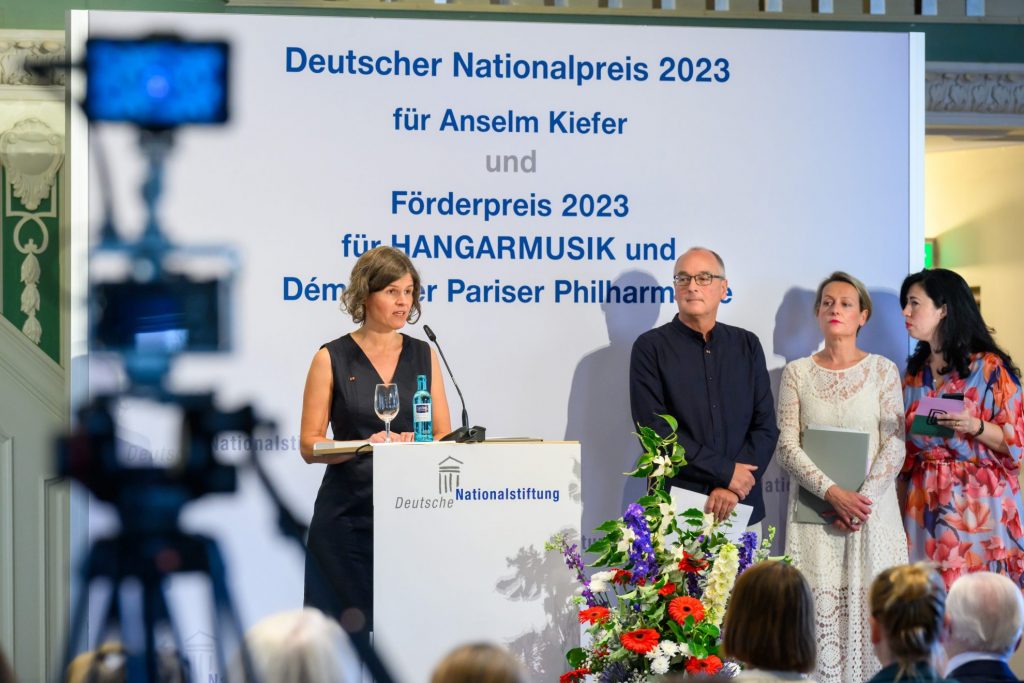
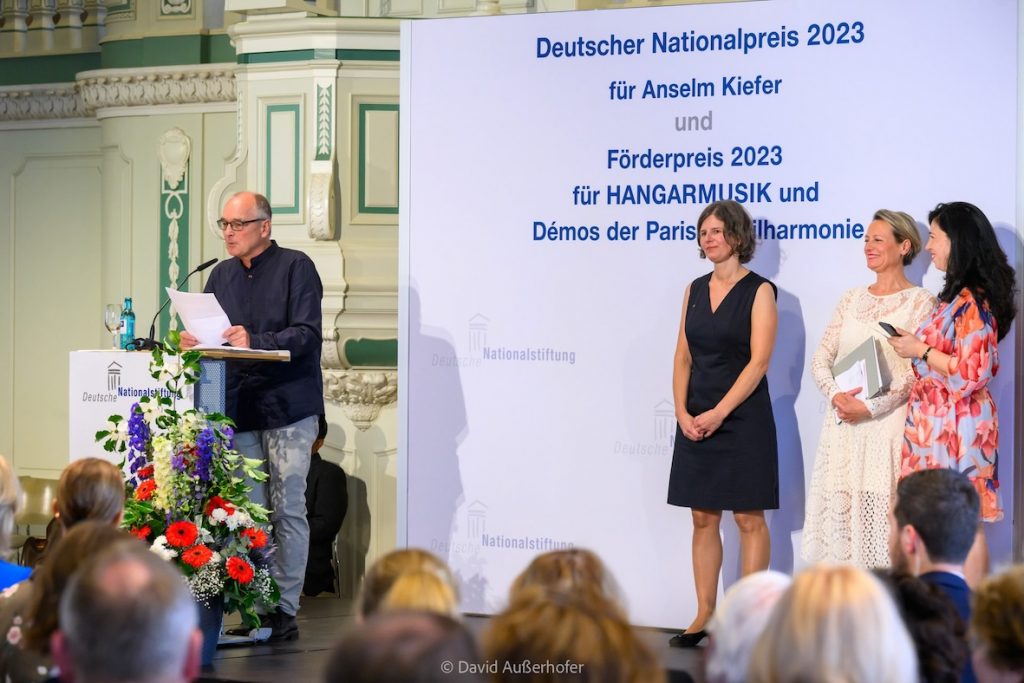
Thank you very much for your commendatory speech, dear Ms Goulard,
Dear Mr Mirow, dear Mr Voßkuhle, dear members of the jury, dear Minister President Rehlinger,
Dear Mr Kiefer, the topic of borders is also a very important and very touching one for us.
When we first walked through the overcrowded hangar halls of the emergency accommodation at the former Tempelhof Airport in 2016 to invite the newly arrived children to make music with our string instruments, we could never have imagined that it would lead to us receiving this award with our orchestra today.
HANGARMUSIK and "Demos" played a concert on 22 January this year in the middle of Anselm Kiefer's artworks at the Pantheon Paris, without knowing that this day would bring us together in this way.
We are happy to receive the sponsorship award with our friends from the orchestra project Demos of the Philharmonie de Paris. Already in 2018, a Demos orchestra from Montbéliard was our guest in the customs garage of the airport. On the occasion of France's EU Presidency, we travelled to Paris for the first time in 2022 to be part of the orchestra Demos Europe.
I grew up in Saarland on the Franco-German border. As a child, when I looked at the world map on the wall in my father's room, I always asked myself: why was I born right here? Although we regularly had to pass through border controls, I felt that France was part of my home country. Later I experienced that borders can have a completely different meaning, that was in Greece. It was a shock!
In 2021, we spent nine months there in the Vial hotspot on the so-called European external border, working with refugee children and young people on music by Beethoven and Mahler on violins and cellos. And all this in the midst of misery, hardship, despair and ongoing pushbacks in which refugees are still losing their lives in the Mediterranean. Three weeks ago, this situation reached a shocking, unimaginable level.
In the epilogue of Toni Morrison's novel "Recitatif", Zadie Smith writes : writes in the epilogue to Toni Morrison's story "Recitative":
"Wanting to be heard is what makes people human. If we are not heard, we are nobodies. As soon as we consciously turn away from any form of suffering, we transform the boundary between ourselves and the rest of humanity, which should be permeable, into something rigid and deadly. We claim not to want to be bothered with the history of the nobodies, with the suffering of the nobodies."
The young musicians playing here today may come from all over the world, but Berlin has become a home for all of them. This makes it all the more incomprehensible that even after years, some of our orchestra members still have no prospects of staying, and are not even allowed to leave Berlin, and this in spite of having integrated in Berlin in every other way and even having excellent grades.
Due to a political decision in 2015, refugee families and their children were able to come to us across multiple borders. Will this still be possible in the future? Is it fate or just random luck to be born in Europe? Does humanity have borders?
There are no borders in music. We can play it together anywhere, without needing to speak the same language. It was out of love for music, empathy, humanity and a sense of responsibility for people forced to flee that our wonderful musical community was born.
(Leila Weber)
“A miraculous sound machine of people” This is how Nikolaus Harnoncourt defined what an orchestra is. Here is such a "miraculous sound machine". All children can play orchestral music. With this philosophy, we have created a musical sanctuary in which children, young people and adults can create music together: HANGARMUSIK.
Take a string instrument and pluck the open strings D - A, D - A, and you have the opening sequence of Gustav Mahler's Symphony No. 1 - in the original key! Something so simple enables both beginners and professionals to make music together from day one. You will hear this in our last musical performance.
Creating your own musical voice within a community is a deeply democratic process. It allows individuals to realize "my voice" counts, that "my contribution" is recognised. At the same time, it teaches a sense of shared responsibility for the overall community. Because one note missing is a loss for everyone! The beauty of orchestral music is that even where it contains dissonance, there is still unity in the end. That is also where music differs from sports. Sports are innately competitive and the fastest wins. With us, the fastest never wins.
Orchestral music cannot be neatly confined into national categories either. It reflects the history of mankind as well as the history of musicians. We all know the term "Made in Germany". Today we listen to music "Made in Germany" - and at the end no one will ask: "Made from which nationality?"
So let's expand on the term "nation": Nation - a collective of people who enrich this country by togetherness, by uniting to create music which resounds and can be heard.
Leila Weber has just pointed out the alarming political situation within which our work operates. In the writings of Fritz Bauer we have found a leitmotif for this. Mr Voßkuhle, you know what we are talking about. More than 60 years ago, he formulated a compass to guide human action:
"We cannot make heaven out of the earth, but each of us can do something to prevent it from becoming hell."
By honouring Demos and HANGARMUSIK, you are drawing attention to the art form of orchestral music, whose potential as an integrative and social force is still given far too little attention in this country. France is already a big step ahead with the DEMOS project.
We would like to thank the children and young people of HANGARMUSIK as well as our team for their enthusiasm for making music together, the private sponsors without whom we could not realise HANGARMUSIK. We are happy that some of you are here.
And of course we thank the German National Foundation, you Mr Mirow, Mr Voßkuhle and the jury, you Ms Goulard and Ms Klaus with your team.
From the bottom of our hearts we thank Anselm Kiefer! For your generosity, and for opening our senses with your work. What you make possible through the prize money is far more than the promotion of musical work with children and young people.
They enable us to make the world more humane after a hell.
Thank you!!!
(Andreas Knapp)
© Hangarmusik – Leila Weber & Andreas Knapp